


Sometime in the Fall of 2020, I started to lose my mind. Those who know me understand this is not an uncommon occurrence. Going back through my diaries to find the exact “day it happened”, I see the thoughts of a young man struggling to make his mark in the world – to synthesize his many skills, talents, and interests into something beautiful – and useful.
On one hand, he understood he was an artist at heart, dedicated to using the mandolin to convey his ideas. On the other, a lifelong habitual “tear it apart and see how it works” type. For a few years prior, he’d been exhausting himself at various attempts to merge these hemispheres: painting with guash in grid-lined laboratory notebooks, writing LISP and C programs as if they were occult spells, composing songs in a type of music notation that used grid paper, etc. The I-Ching, psychics, and astrologers were all consulted but to no avail. All of these diversions did not end his problem. He was looking for his Philospher’s Stone.
Then one night he decided he was unhappy with mandolin pickups. He decided to make a drawing: F-hole shaped foam inserts with piezoelectric filaments buried within them. The idea being, you could shield the feedback noise from entering the sound chamber. Another drawing was made the same evening. “Why use piezos when they aren’t feedback resistant?” So he drew what appears to be an electromagnet clamped onto the bridge with a volume adjuster. Perhaps he thought, “this will be easy I’ll have this done in no time!”
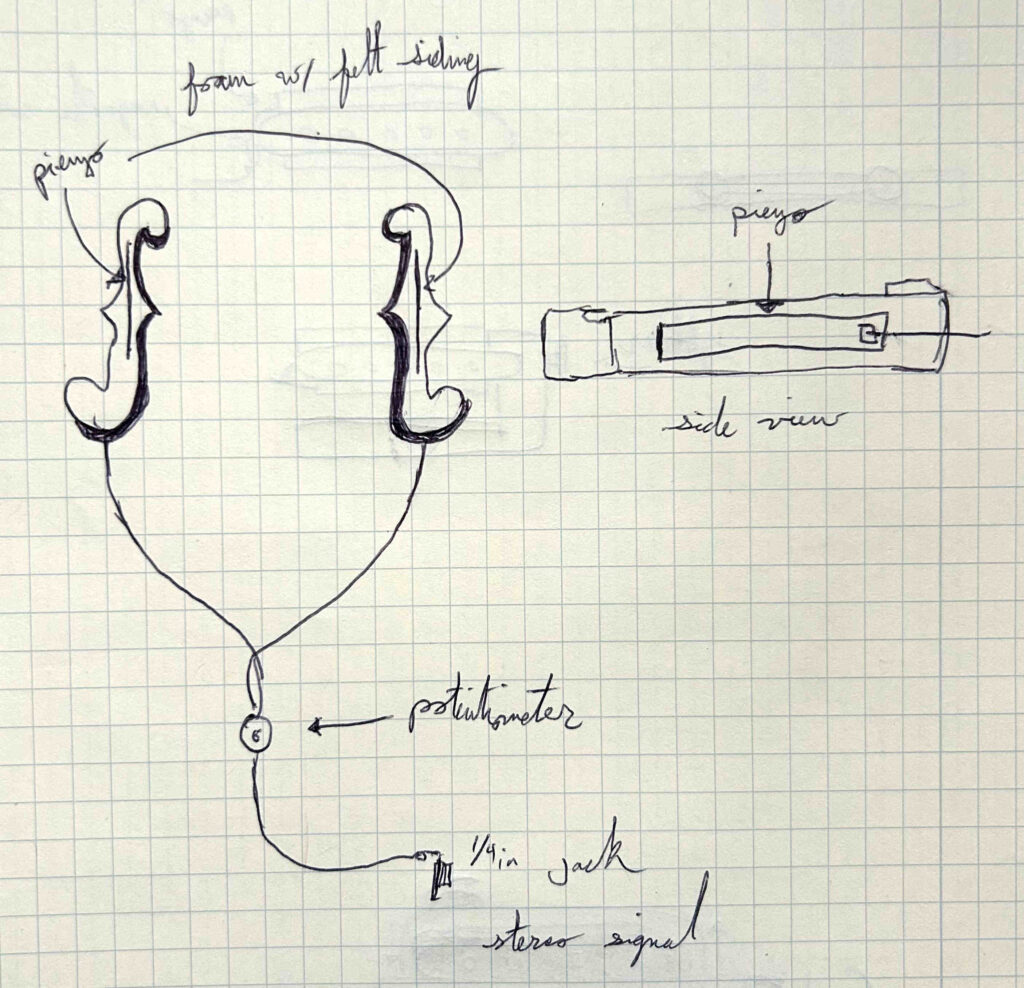
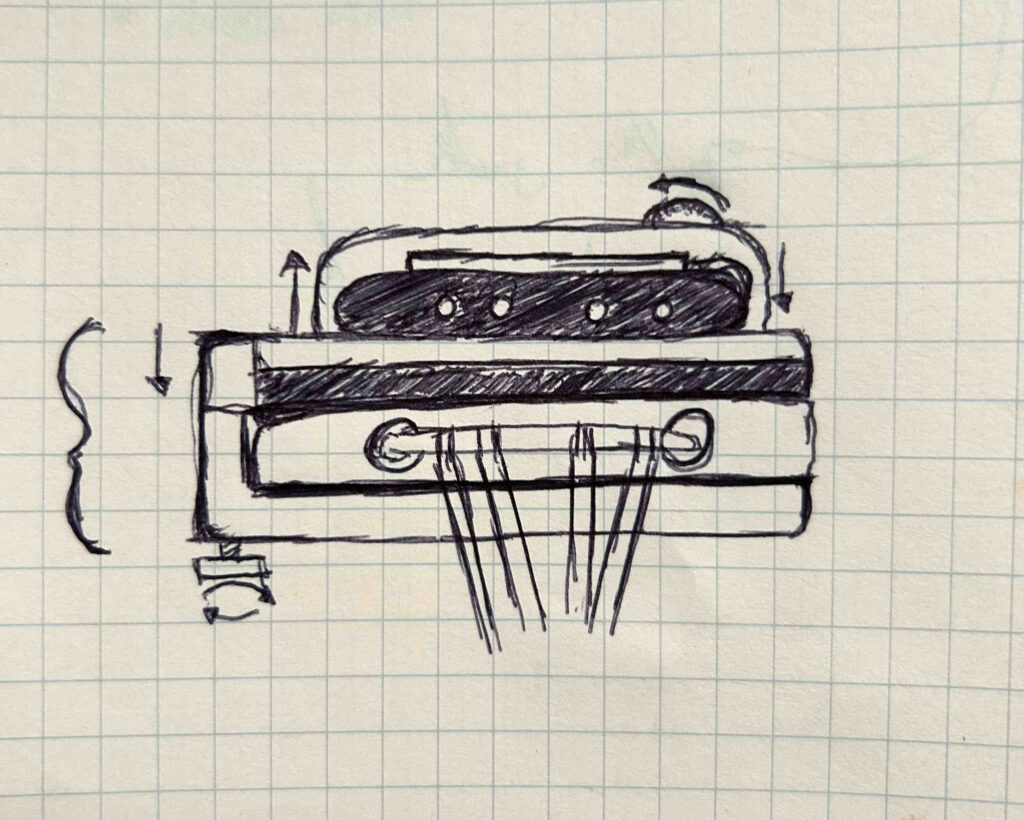
Time would prove otherwise. But before him now was a synthesis of the technical and the romantic – had he found what he was searching for? What he drew that evening would not be the recipe for his Philospher’s Stone, but now he knew where to find it. I’m immensely proud that young man stuck with it for so long. Five years later, I’m finally able to bring the first version to other musicians and using it in my own work with The Resonauts.
Many folks I’ve talked to don’t really see why pickups are so important, especially mandolin pickups – “Good luck with that.” They are perceived as a means to an end and nothing more. This is wrong on many levels. Pickups connect what is within the artist to an audience – they extend the golden ladder of musical forms to large crowds of people. Even more, what an artist is capable of expressing is also highly dependent on how they feel on-stage. Nothing will ruin a mood faster than feedback issues. Everyone, including pickup manufacturers, seems to take this for granted.
The fact that the most popular mandolin pickups are the exact same brand and model as they were when I started playing 18 years ago is unacceptable. There has to be something better, and in fact, I know there is. Right now I’ve selected mandolin players in the Nashville area to test drive them and check for any issues before the official beta release.
If you’re interested, join the wait list and be the first to know when the pickups are out!