Category: pickups

  • Alpha Release is Here

    Alpha Release is Here

    Sometime in the Fall of 2020, I started to lose my mind. Those who know me understand this is not an uncommon occurrence. Going back through my diaries to find the exact “day it happened”, I see the thoughts of a young man struggling to make his mark in the world – to synthesize his many skills, talents, and interests into something beautiful – and useful.

    On one hand, he understood he was an artist at heart, dedicated to using the mandolin to convey his ideas. On the other, a lifelong habitual “tear it apart and see how it works” type. For a few years prior, he’d been exhausting himself at various attempts to merge these hemispheres: painting with guash in grid-lined laboratory notebooks, writing LISP and C programs as if they were occult spells, composing songs in a type of music notation that used grid paper, etc. The I-Ching, psychics, and astrologers were all consulted but to no avail. All of these diversions did not end his problem. He was looking for his Philospher’s Stone.

    Then one night he decided he was unhappy with mandolin pickups. He decided to make a drawing: F-hole shaped foam inserts with piezoelectric filaments buried within them. The idea being, you could shield the feedback noise from entering the sound chamber. Another drawing was made the same evening. “Why use piezos when they aren’t feedback resistant?” So he drew what appears to be an electromagnet clamped onto the bridge with a volume adjuster. Perhaps he thought, “this will be easy I’ll have this done in no time!”
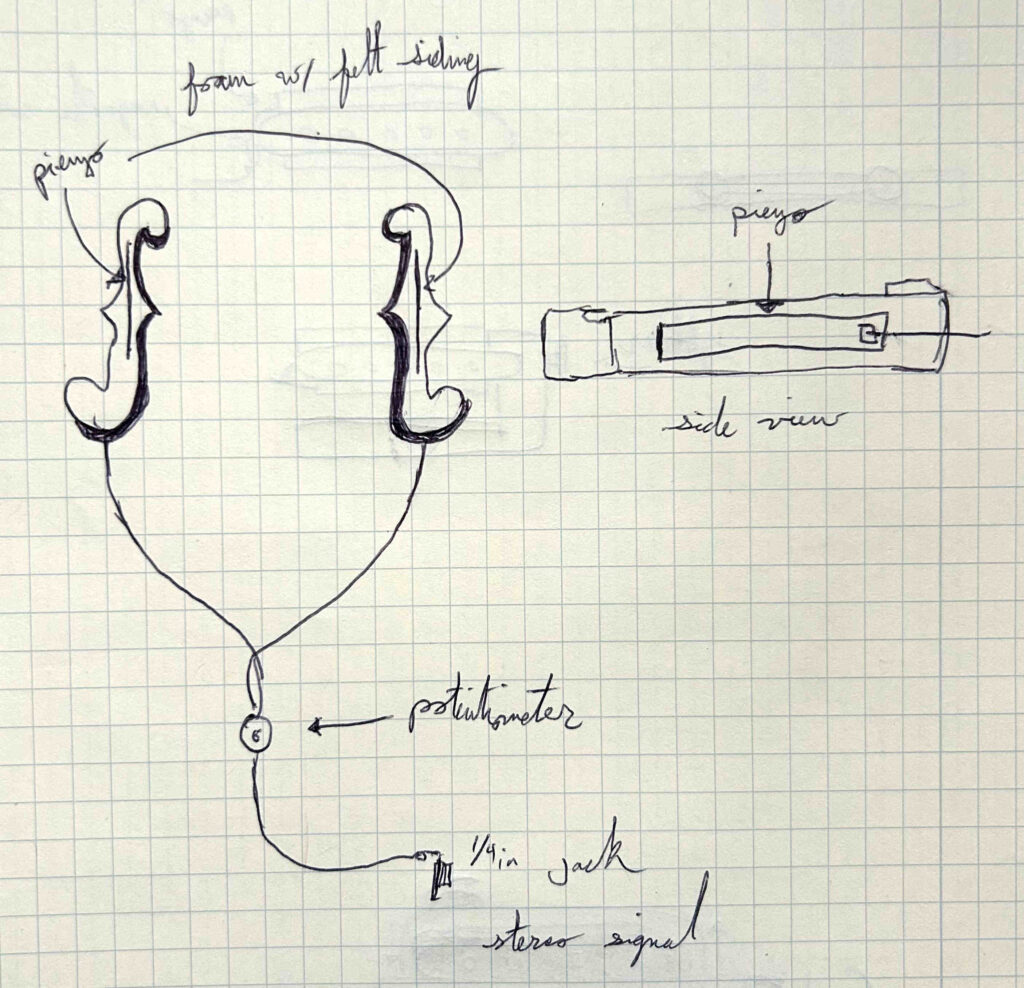
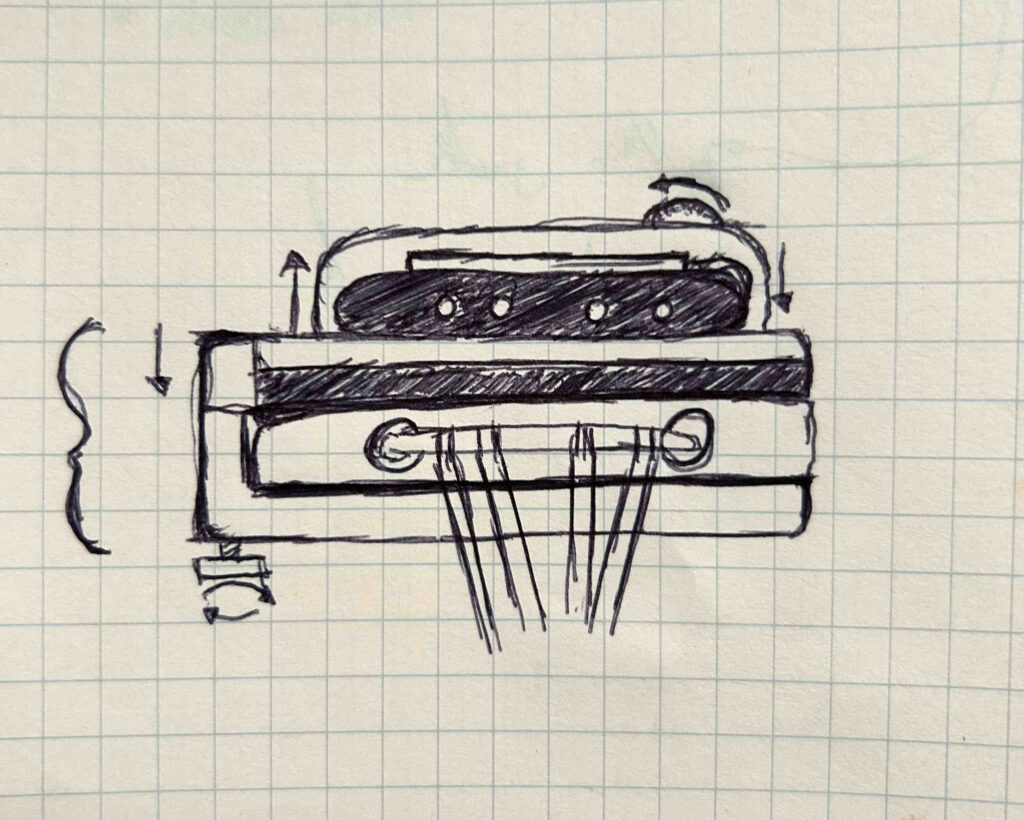
    First drawing
    Second drawing

    Time would prove otherwise. But before him now was a synthesis of the technical and the romantic – had he found what he was searching for? What he drew that evening would not be the recipe for his Philospher’s Stone, but now he knew where to find it. I’m immensely proud that young man stuck with it for so long. Five years later, I’m finally able to bring the first version to other musicians and using it in my own work with The Resonauts.

    Many folks I’ve talked to don’t really see why pickups are so important, especially mandolin pickups – “Good luck with that.” They are perceived as a means to an end and nothing more. This is wrong on many levels. Pickups connect what is within the artist to an audience – they extend the golden ladder of musical forms to large crowds of people. Even more, what an artist is capable of expressing is also highly dependent on how they feel on-stage. Nothing will ruin a mood faster than feedback issues. Everyone, including pickup manufacturers, seems to take this for granted.

    The fact that the most popular mandolin pickups are the exact same brand and model as they were when I started playing 18 years ago is unacceptable. There has to be something better, and in fact, I know there is. Right now I’ve selected mandolin players in the Nashville area to test drive them and check for any issues before the official beta release.

    If you’re interested, join the wait list and be the first to know when the pickups are out!
  • Gaglio’s Double Winding Patent

    Gaglio’s Double Winding Patent

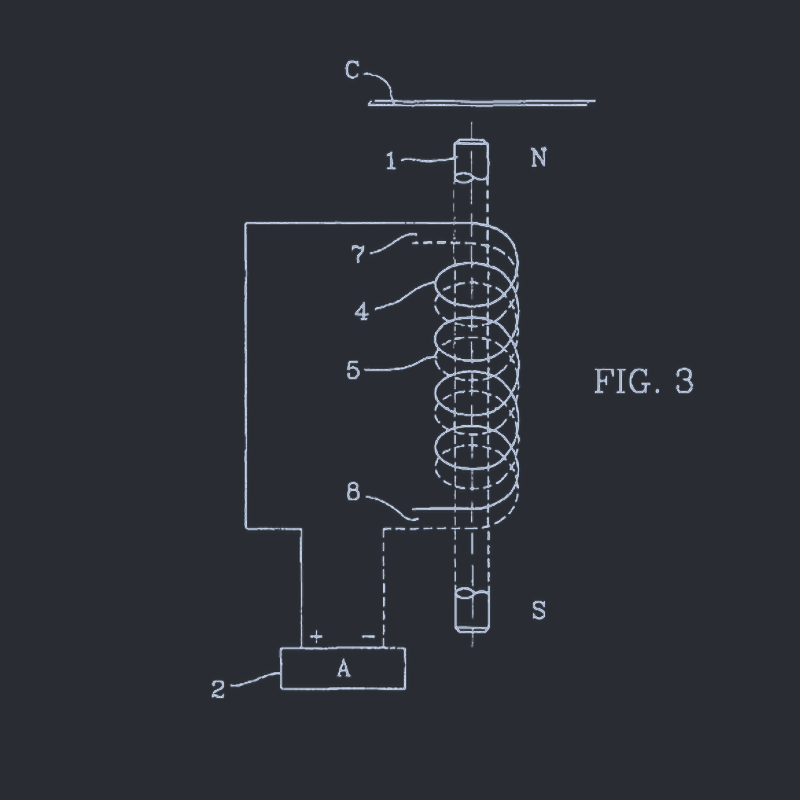
    I found this patent recently and was impressed with it’s simplicity. Filed in 2001 by Giovanni Gaglio, it appears to be a magnetic pole piece with two wires wrapped around it, rather than one. How is this a novel advancement? Gaglio explains the issue his invention solves:

    In particular, it has been found that output level on one hand, and fidelity and capacity to reproduce an extended frequency range on the other hand are contradictory properties. In fact, by increasing output level in volts of the pick-up device, gradually the capacity to reproduce high frequencies is lost, whereas an extremely accurate pick-up device, able to reproduce a wide frequency range cannot offer an adequate output level.

    Electromagnetic pickups are just that – electromagnets: a magnetic material wrapped many (usually hundreds) of times with very thin copper wire. When an electromagnet is placed underneath metal strings, the strings become partially magnetized and are effectively a part of the magnetic field. As strings vibrate this disturbance causes a momentary collapse in the field and frees electrons to pass down a circuit. That phenomenon is called induction.

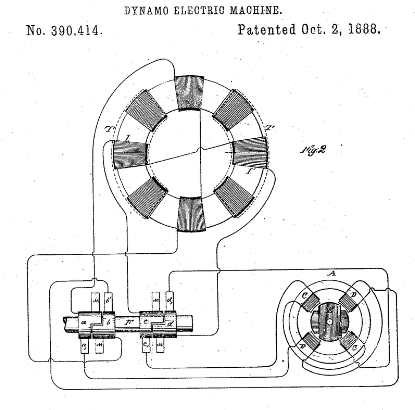
    Electric generators follow this same principle: pass a magnet over copper wire to induce voltage. Increasing the number of turns of wire and its respective gauge, produces more voltage. Nikola Tesla’s Dynamo Electric Machine took this principle and by spinning magnets of opposite polarity, was able to induce large voltages with sinusoidal uniformity, and thus created alternating current.

    US390414A Tesla’s Dynamo Generator

    With the phenomenon of induction in mind, what does Gaglio mean that “increasing output voltage hurts the ability to reproduce high frequencies”? As the number of windings increases around the magnet, it effectively increases the resistance of the pickup itself. Higher resonant frequencies and overtones have far less energy to induce change in the magnetic field and travel through this increased resistance and so, are attenuated. It’s for this reason that many electromagnetic guitar pickups targeting acoustic guitars sound way too muddy from the low end, and do not faithfully reproduce the acoustic “shimmer”.

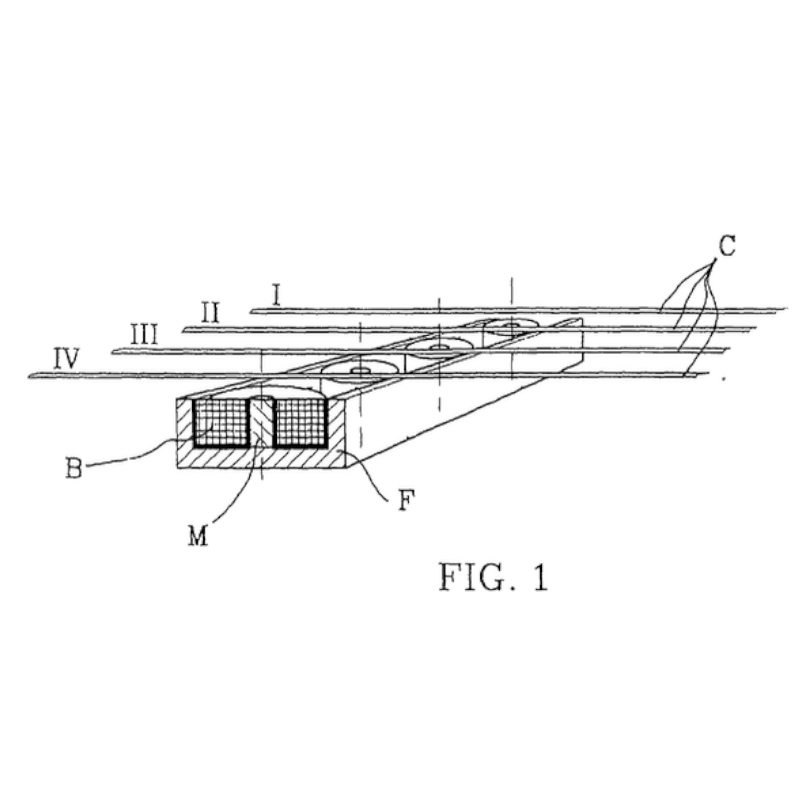
    Figure 1 from Gaglio’s Patent Showing a typical pickup, although the copper wire is wrapped around magnets individually.
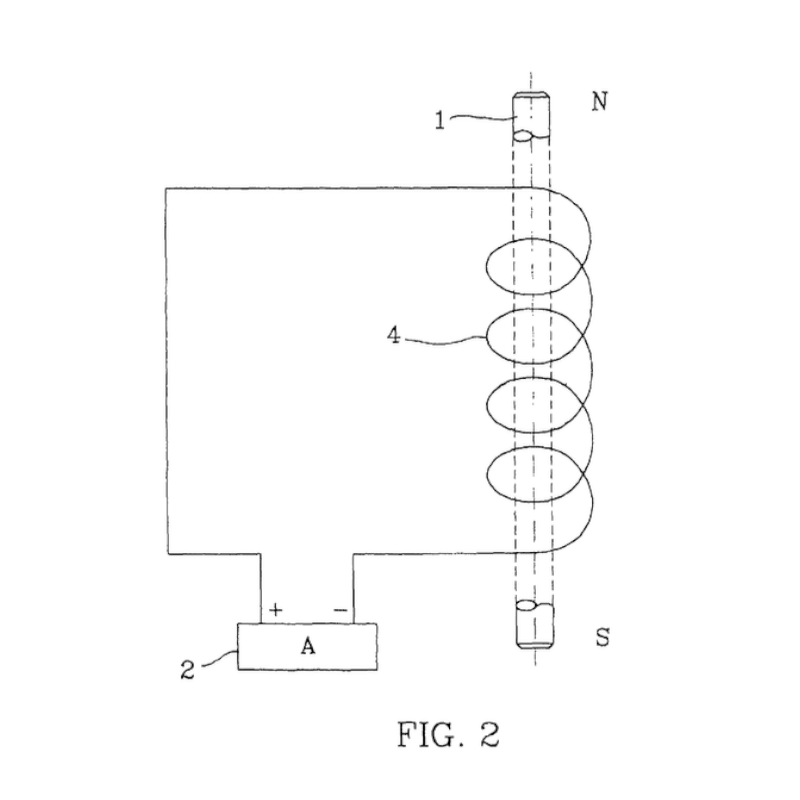
    Figure 2 shows a more simplified view. The copper wire is wound around an individual magnet with it’s leads terminating at a positive and ground node.

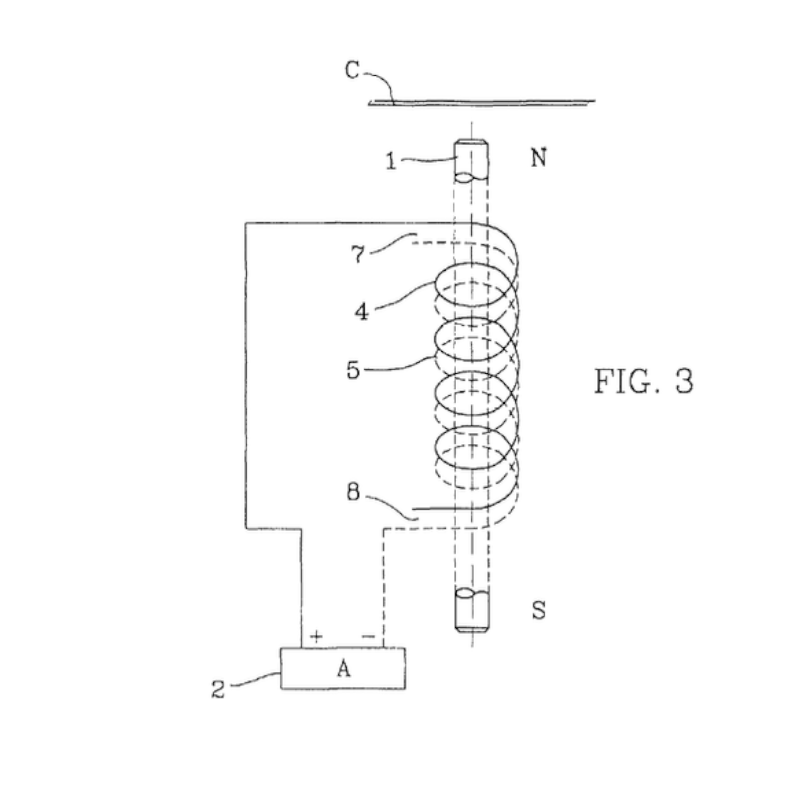
    So what is Galgio’s solution here? It is remarkably simple but not obvious. Figure 3 shows a doubling of the wire in figure 2, one wire being solid (lead 4) and the other dashed (lead 5) to distinguish them. Notice that the wires do not have continuity but remain unconnected (see points 7 and 8 in Fig. 3). How is electricity supposed to flow?

    We are left with the briefest explanation and no further elaboration:

    The continuity in the transmission of signal between lead 4 and lead 5 of the double-lead winding is obtained through the capacitor ideally as the result of the amount of parasite capacities that are generated between each turn of lead 4 and the one of the lead 5.

    By “parasite capacities” he’s referring to the property known as parasitic capacitance: a usually undesired side-effect where two different charge carrying transmission lines are close enough in proximity to one another that they form a capacitive coupling. As with any capacitor, signals can flow through this coupling and that’s exactly how the circuit in Figure 3 is completed.

    The “output voltage vs frequency response” issue is fixed because the path taken from lead 4 to lead 5 is through the parasitic capacitor formed across the two windings, despite ends of the windings being unconnected. Thus, you can wind a lot of wire to get a higher output voltage and still get the higher frequencies.

    Sadly, I’ve been unable to find any examples of Gaglio’s concept, so it’s difficult to say whether it would work, or if the corresponding amount of wire turns would have to be so high, it didn’t make such an arrangement practical.To say there is a lesson is probably quite unnecessary and pedantic, but I’d recon it would be something like:

    “There’s always another path you can take.”

  • DeArmond’s “Pickup and Volume Control” Patent

    DeArmond’s “Pickup and Volume Control” Patent

    Perhaps no one in the 20th century thought more about the method of attachment to arch-top bridges than Harry DeArmond. A prolific designer, inventor, and musician, he is credited with inventing the first commercially available attachable guitar pickup in the 1930s. Amplification of stringed instruments was then in it’s infancy. The instruments that did have pickups installed were integrated into the body, like a lap steel.

    Much of the instruments owned and played were at the time of course, only acoustic. When money was sparse, how was a musician to be heard on the increasingly loud stages of the jazz era? DeArmond’s designs appear to seek the preservation of what was great about the acoustic instruments of the period while also allowing them to be heard. Being a simple, cost-effective add-on for the musician rather than having to outright purchase a new instrument, it’s no surprise these floating pickup designs are still in use by jazz artists today.

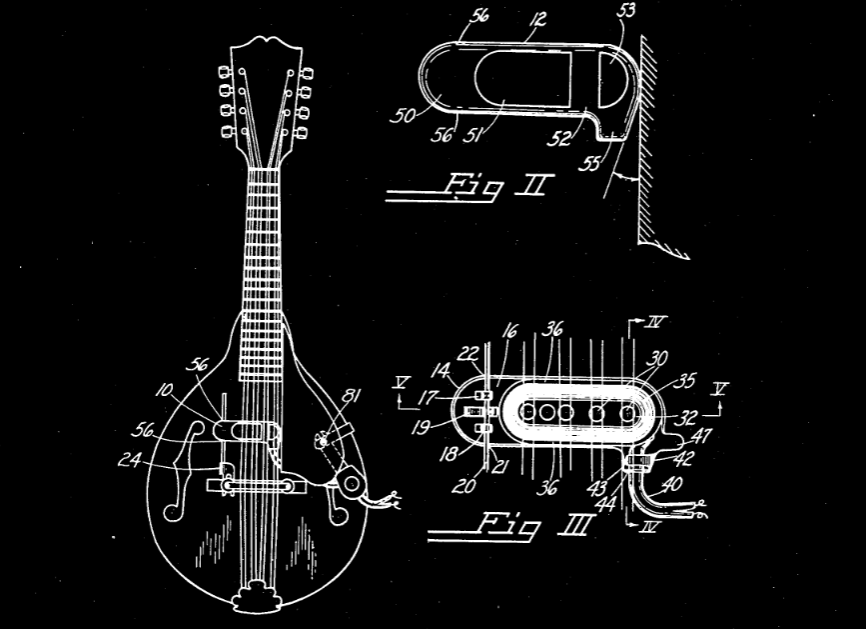
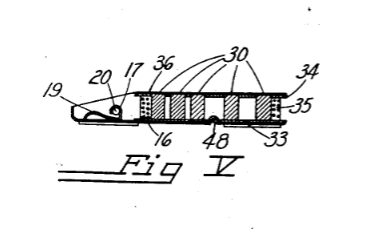
    One of these designs appear to target the mandolin player. US Patent No. 2455567A shows a Honer-esque A style mandolin with a floating electromagnetic pickup. Unlike his famous “Monkey-on-a-stick” where the “stick” makes a touch-less wrap around the player side of the bridge, the base of the stick here braces a fork on the player side bridge adjustment screw. He refers to this as “a bifurcated supporting bracket, the two ends of which are adapted to slide under the knurled nut…”

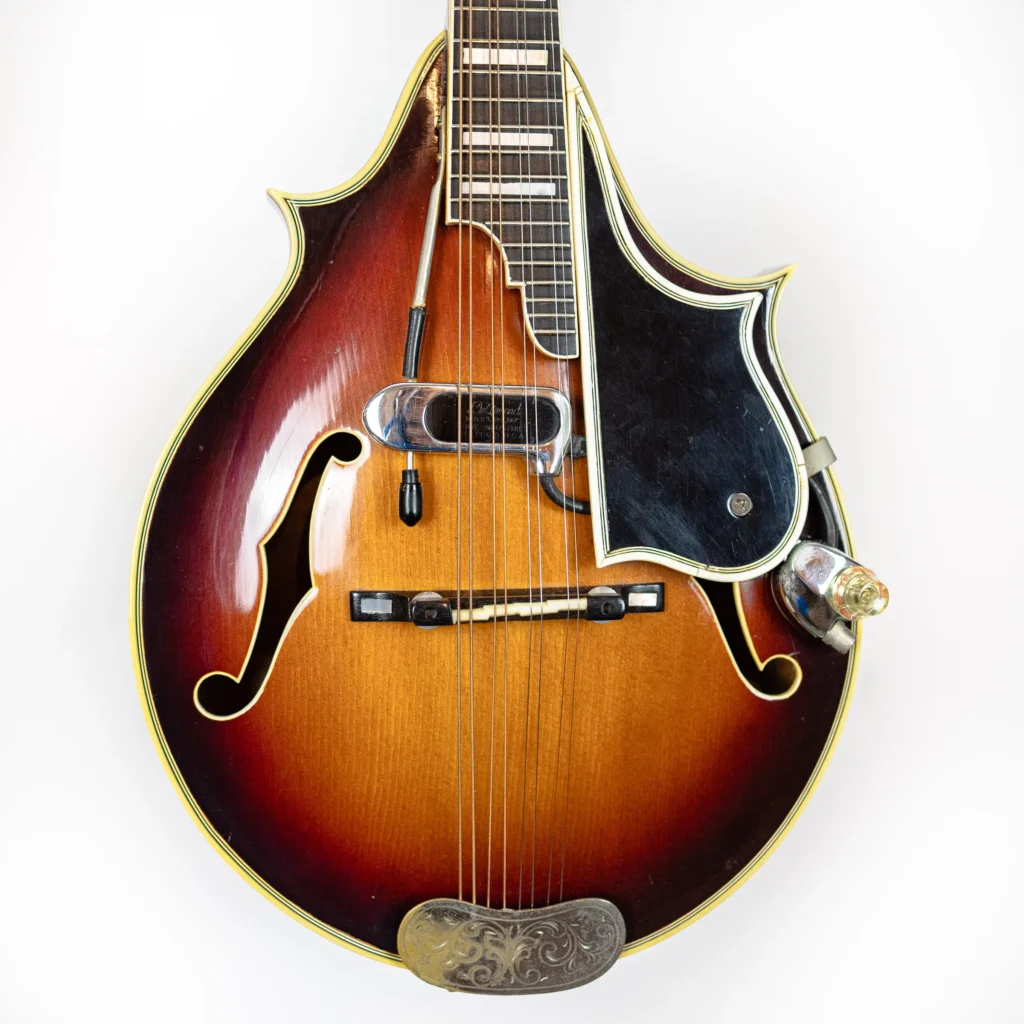
    I haven’t been able to find any surviving examples of the stabilizing fork protruding from the bridge. Perhaps this design was never used in production, or given the fact a rod can be inserted from both ways into the coil casing, the rod was preferred to extend from the neck down, or the classic bridge wrap around worked better, the other rod shaped being discarded. Examples of these methods do survive.

    DeArmond Pickup with “stick” extending from above
    Classic “Monkey-on-a-stick” bridge wrap around

    Another interesting find is in Figure 5, which shows a very nice cutaway heel on the player side – no doubt to prevent the playing hand from brushing against the electromagnet. My earlier designs included this slope, almost to the same angle and extent as DeArmond’s! Convergent evolution.

    DeArmond’s sloped heel
    An earlier “DreamSnake” design of mine with a similar slope

    August 7, 2025 Update:

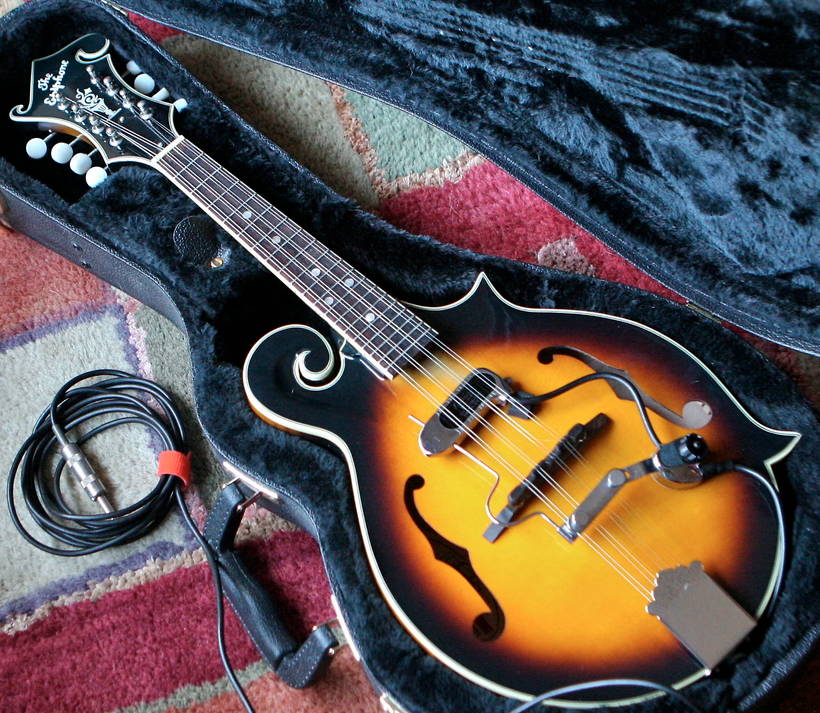
    I stumbled upon an example of a stabilizing fork being used at present in the Shadow SH 928. It surprisingly appears situated above the adjustment wheel on the treble side, implying the strings have to be slack before the fork can be inserted:

    Shadow SH 928 with a stablizing fork on the bridge